
Posts | Videos | Post Video | Structural Integrity | Warranty | Repairs & Renovations | Pole Barn Insurance
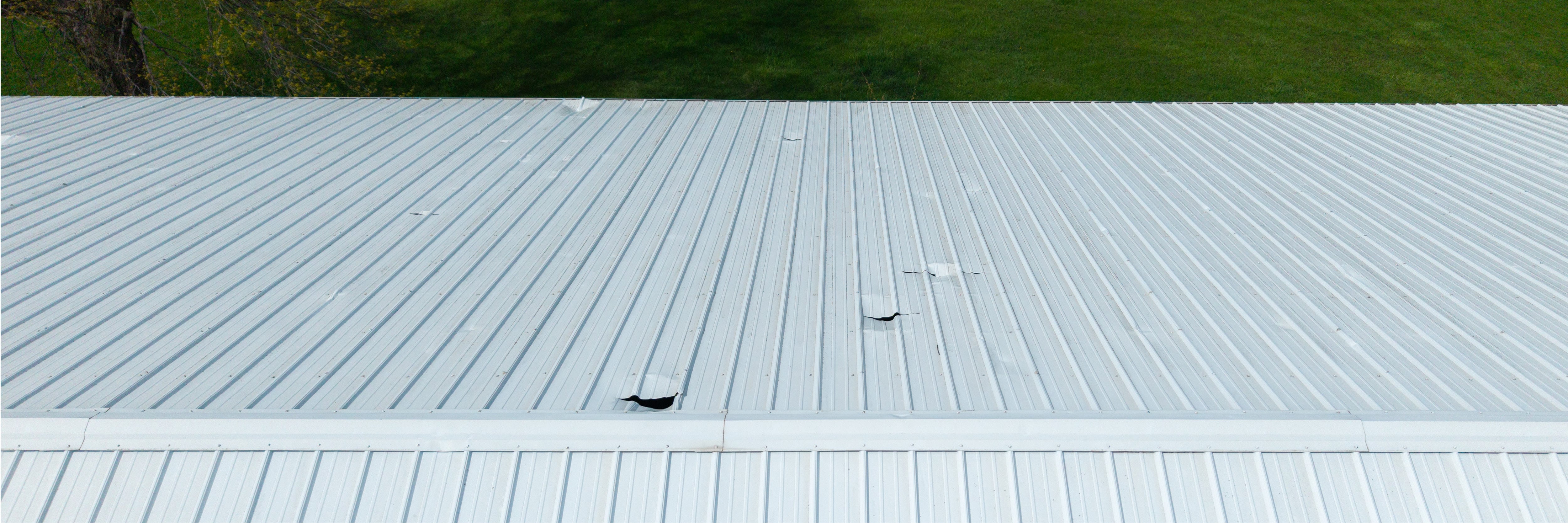

Warm temperatures and storm season have arrived.
Fallen trees, missing shingles, and wind-damaged structures are the first signs of severe weather property owners notice.
But not all storm damage is obvious. Hail impacts on metal roofing and siding can be harder to identify, especially from the ground. The pole barn roof isn’t leaking, and everything appears to be functional.
That’s when insurance companies often tell property owners, “It’s just cosmetic.” At first glance, the explanation seems reasonable.
However, hail damage isn’t always straightforward. This is where the disputes arise: what is visible, what can be verified, and what can be inferred about the steel panel’s long-term performance.
This article covers the following information:
- How metal roofing systems react to real-world weather conditions
- What metal manufacturers and testing standards say about hail impacts
- Key considerations for post-frame building owners dealing with storm damage

How Does Hail Form?
Before discussing hail damage to metal roofs, it's helpful to understand how hailstones form.
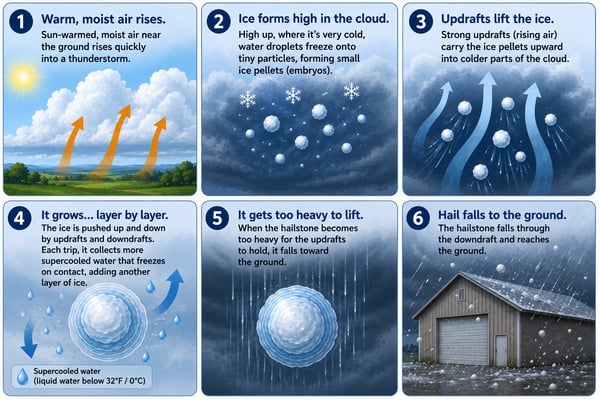
Hail forms inside strong thunderstorms when warm, moist air near the ground rises into the atmosphere. As the air climbs higher into the storm cloud, temperatures drop below freezing. Water droplets freeze into tiny ice particles, creating the foundation of a hailstone.
Strong updrafts carry the ice particles upward into colder parts of the cloud. As they travel, the ice particles collide with supercooled water droplets. This liquid remains unfrozen despite temperatures below 32ºF. When these droplets contact the ice particles, they freeze instantly and add another layer to the growing hailstone.
The process repeats multiple times. Powerful updrafts can push the hailstone higher into the cloud. Downdrafts pull it back down. As the hailstone moves through the storm, it collects new layers of ice, growing larger and heavier.
Eventually, the hailstone becomes too heavy for the updrafts to support. When gravity overcomes the upward force of the rising air, the hailstone falls through the clouds to the ground. The stronger the updrafts, the larger the hailstones can become before falling from the sky.
How Does Hail Damage Affect Metal Roofing Panels?
While it is important to understand how hail forms, the primary concern for pole barn owners is its effect on their metal roofing systems.
To find out, we conducted a controlled hail damage test using different-sized ice molds and a DIY air cannon. The overall goal was to simulate real-world weather conditions and observe how hailstones impact steel panels.
Our research included four common hail sizes:
- Pea-sized hail (0.25”)
- Golf ball-sized hail (1.75”)
- Baseball-sized hail (2.75”)
- Softball-sized hail (4.00”)
The results showed a clear relationship between hail size and the extent of damage. Here’s what happened when we launched each hailstone at the steel panels.
Pea-Sized Hail (0.25")
 Pea-sized hail falls from the sky at speeds of 20 to 25 MPH.
During our test, these smaller hailstones bounced off the steel panel with little to no visible sign of impact. This misunderstanding is where the conflict over hail damage starts.
Many insurance agents and property owners assume that if they cannot see hail damage, it does not exist. There are tiny imperfections, called “microscopic fractures,” in the paint system and the protective coating.
Moisture can penetrate the metal roofing and siding over time, leading to corrosion and reduced panel life. This outcome shows how visual inspections can miss damage that occurs beneath the surface.
Golf Ball-Sized Hail (1.75")
 Golf ball-sized hail can reach speeds of 50 MPH before hitting a metal roof. Unlike smaller hailstones, these impacts produce noticeable dents.
Even though the steel panel was not punctured, the visible dent shows how quickly hail can damage a metal roof.
At this level of damage, insurance claims and assessments become more complicated. The post-frame building may remain functional despite obvious signs of impact.
Baseball-Sized Hail (2.75")
 Baseball-sized hail is capable of reaching speeds of 70 to 80 MPH and occurs during severe weather outbreaks. These hailstones can easily crack vinyl siding or break windows on a stick-built home.
In our testing, baseball-sized hail caused significant dents but did not puncture the steel panel. This result demonstrates the strength of our building materials.
Our in-house structural engineers prefer 29-gauge, heat-treated, full-hard, high-tensile steel with a minimum yield strength of 80,000 PSI.
Softball-Sized Hail (4.00")
 Softball-sized hail is extreme, falling at speeds of up to 100 MPH.
This large hailstone was the ultimate test for our steel panel, which it eventually punctured.
While hail of this size is rare, it shows that even tough building materials can fail in severe weather.
Once a metal roof is exposed, the concern shifts from appearance to structural integrity. Water can enter the post-frame building. It can damage farm equipment, vehicles, livestock feed, tools, and other valuables stored inside the pole barn.
What Did the Hail Damage Test Reveal?
While large hailstones can leave obvious damage, appearance tells only part of the story.
According to metal manufacturers, a steel panel’s condition cannot be determined through visual inspection alone. Hail impacts may affect the paint system and protective coatings beneath the surface.
This uncertainty is what makes hail damage so controversial. If you can't always see the full extent, how do you know whether your metal roof has been compromised?
To address this concern, we examined what metal manufacturers say about hail impacts and steel panel performance.
 What Do Metal Manufacturers Say About Hail Damage?
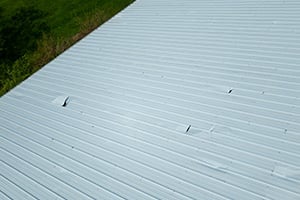 Metal manufacturers say that hail damage isn’t always straightforward.
Laboratory testing can assess the impact resistance and coating performance of metal roofing systems.
However, manufacturers note that this process is often impractical and inconclusive in real-world conditions.
Steel panels must be removed from the post-frame building and sent to a laboratory for evaluation. Then, the pole barn must be re-roofed, adding post-frame construction labor and building material costs.
Even after testing is complete, the results apply to the specific metal panel examined.
Assessing hail damage across an entire metal roofing system is significantly limited by this process. A single pole barn may have hundreds of steel panels exposed to different-sized hailstones, impact angles, and wind speeds during a storm.
Because of these variables, one steel panel shouldn’t represent the condition of the entire metal roof.
What Should Pole Barn Owners Do After a Hailstorm?
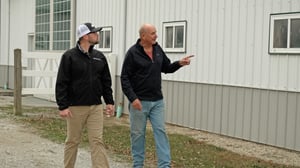 A hailstorm can leave behind both visible and hidden storm damage. Even if your metal roof or siding appears normal, don’t assume everything is fine based on appearance alone.
Here are the key steps every pole barn owner should take after a severe weather event:
1) Document the Pole Barn Storm Damage
Start by taking photos of your post-frame building as soon as it is safe to do so. If possible, capture images of visible hail impacts and the storm's aftermath, including downed trees and debris. Be sure to note the incident, date, time, and other details. This documentation will be helpful for insurance purposes.
2) Review the Warranty from the Metal Manufacturer
Next, review the metal manufacturer’s warranty for your metal roofing system. Some warranties may include specific language regarding hail impacts and how they affect coverage. Understanding these terms clarifies what is covered following a storm.
3) Schedule an Inspection with a Post-Frame Builder
Finally, request a professional inspection with a post-frame builder with a dedicated repair team. Trained eyes can spot hail damage that you may not see from the ground. This expertise gives a more accurate assessment.
Bottom Line: Hail Damage to a Metal Roof is More Than "Just Cosmetic."
Metal manufacturers acknowledge that hail damage may not always be visible. Laboratory testing is often impractical and inconclusive, creating uncertainty around long-term performance and warranty coverage.
For pole barn owners, the real question isn’t whether a dent looks bad—it’s whether their metal roofing system will continue to provide the same protection and lifespan it had before the storm.
Does your post-frame building have hail damage? Schedule a FREE inspection with the post-frame construction experts. This detailed report provides a comprehensive review of your pole barn’s condition, helping you identify potential issues and maintain its optimal shape for years.
Editor’s Note: This document is intended to identify necessary repair work or assist with updating an insurance policy, not for use in legal proceedings.

Do you have more questions that aren’t covered in this article? If you need help designing or planning, please contact FBi Buildings at 800.552.2981 or click here to email us. If you’re ready to get a price, click here to request a quote, and a Customer Engagement Team member will help you determine the next steps.