
Posts | Videos | Post Video | Building Features | Structural Integrity | Comparisons | Repairs & Renovations | Site Preparation | Product Review


When planning a new pole barn, it’s easy to focus on the big decisions—size, metal roof style, or color combinations. However, small post-frame building components, such as your gutter system, play a crucial role in protecting your investment.
One question we hear from property owners is, “Are steel gutters stronger than aluminum gutters?” Post-frame construction companies commonly use both building materials. But they serve different applications and withstand different demands.
Rather than relying on manufacturer claims, we wanted to see how the two eavestroughs compared in real-world scenarios. We tested a standard 5” aluminum gutter against a commercial-grade 6” steel gutter. The purpose is to see how each one performed under the most common causes of damage: ladder pressure and downward forces.
This article discusses our testing process, compares the results, and explains what they mean for your pole barn.
Do you prefer to watch instead of read? Watch this YouTube video to see which gutter system offers greater durability.
Why Does Gutter Strength Matter in Post-Frame Construction?
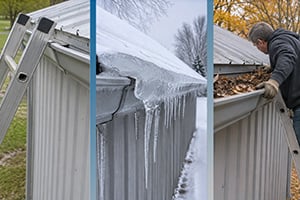 A gutter system is responsible for directing rainwater away from your pole barn foundation. It needs to withstand years of everyday use and seasonal weather without bending, sagging, or failing.
Unlike stick-built homes, post-frame buildings have larger roof spans that collect and channel greater volumes of water. Your pole barn gutters manage significant runoff during heavy rainfall. Moreover, they support the added weight of ice and snow throughout the winter.
Weather isn’t the only source of stress. Everyday activities that you don’t think twice about can harm your gutter system. Avoid leaning a ladder against the eavestroughs while removing leaves, installing holiday lights, or performing regular maintenance. Over time, repeated loads can bend, deform, and weaken the building materials.
Proper installation and routine care maximize the lifespan of any gutter system. Furthermore, the building material itself plays a major role in long-term performance. A stronger gutter is better equipped to resist impacts, support extra loads, and maintain its shape through the seasons.
To better understand how different gutter systems perform, we replicated two real-world scenarios:
- Pressure from a leaning ladder
- Downward forces that simulate the weight of heavy snow, ice, and debris
The results revealed a noticeable difference between aluminum and steel gutters.

Aluminum vs. Steel Gutters: Which One is Stronger?
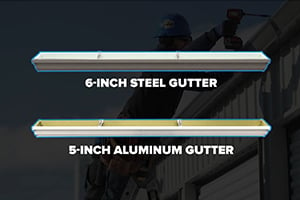 To compare the strength of aluminum and steel gutters, we conducted a series of controlled tests in our research lab.
For this comparison, we evaluated two gutter systems commonly found on stick-built homes and post-frame buildings:
- Standard 5” aluminum gutter
- Commercial-grade 6” steel gutter
We cut each eavestrough into identical 5’ sections. Then, we subjected both building materials to two tests that mimic how gutters fail in real life. The first one reproduced the pressure applied when a ladder leans on the front edge of a gutter. The second one measured how much downward force (from heavy snow, ice, and debris) each gutter can withstand.
Editor’s Note: We didn’t compare aluminum and steel as raw materials only. Instead, our evaluation represents the actual dilemma many property owners face when building a new pole barn.
Overall, we evaluated how each gutter system performed under stress and pinpointed distinct variations in their strength.

Test #1: Ladder Pressure
In many cases, gutter damage is not caused by severe weather. Rather, it occurs during regular maintenance. Leaning a ladder against the front edge of an eavestrough seems harmless. However, it places concentrated pressure that can weaken the gutter system.
To recreate this real-world scenario, we used a hydraulic test to apply increasing pressure to the gutter. Each eavestrough was tested twice under the same conditions, and the results were averaged to ensure consistency.
|
BUILDING MATERIAL |
AVERAGE FAILURE LOAD |
|
Standard 5” Aluminum Gutter |
73.5 lbs. |
|
Commercial-Grade 6” Steel Gutter |
129.0 lbs. |
The commercial-grade 6” steel gutter withstood 129 pounds of force before failing. Meanwhile, the standard 5” aluminum gutter failed at 73.5 pounds—roughly 75 percent of the steel gutter’s strength.
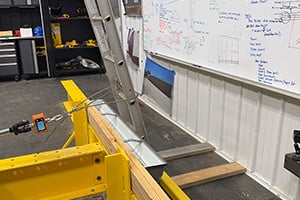 It’s important to understand what these numbers mean in real life. A person weighing 200 pounds doesn’t place their full body weight on the eavestrough when using a properly positioned ladder. The ladder transfers most of the load to the ground.
The top of the ladder receives only 20 to 30 percent of the person's weight. That means a 200-pound person may place approximately 40 to 60 pounds of force on the gutter system.
While both building materials withstood that amount, the aluminum gutter approached its failure point much more closely. Additional force, such as bouncing, climbing, or shifting, can quickly increase the load on the eavestrough.
The steel gutter had a larger safety margin. This strength reduces the likelihood that the gutter system will bend during routine care. It’s a durable option for post-frame buildings that need seasonal upkeep.

Test #2: Downward Forces
While ladders place pressure against the front edge of the gutter, debris and weather can create a different type of stress: downward force.
Heavy snow, ice, and leaves can add weight to a pole barn gutter system. Over time, the eavestroughs will bend, sag, and eventually fail if the load becomes too great.
For our second test, we applied a straight downward force to both gutter sections using the same hydraulic equipment. The load gradually increased until each gutter system failed. This evaluation allowed us to compare how much downward force the aluminum and steel could withstand.
|
BUILDING MATERIAL |
AVERAGE FAILURE LOAD |
|
Standard 5” Aluminum Gutter |
36.0 lbs. |
|
Commercial-Grade 6” Steel Gutter |
95.0 lbs. |
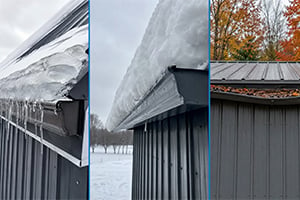 The standard 5” aluminum gutter failed at 36 pounds, while the commercial-grade 6” steel gutter held up to 95 pounds. That’s 2.5 times the downward force of the aluminum eavestrough!
Why does this difference matter?
During the winter months, ice and snow can accumulate on the metal roof and its eavestroughs. Wet snow can become especially heavy. Freezing and thawing cycles allow ice to build up. Leaves can also restrict drainage, adding even more weight.
Our test doesn’t replicate every weather event or debris load a gutter may encounter. However, it demonstrates a significant difference in how the two gutter systems responded to the same downward force.

What Do the Gutter Strength Test Results Mean?
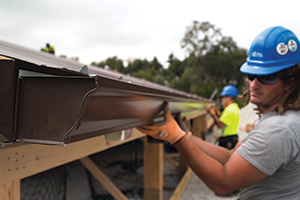 Across both evaluations, the commercial-grade 6” steel gutter outperformed the standard 5” aluminum gutter. The results show that the steel eavestrough provides greater protection against two common causes of gutter damage.
Aluminum gutter systems still have advantages for stick-built homes. This building material is lightweight, naturally rust-resistant, and can perform well when properly sized and installed.
Pole barns present different demands. Their larger roof spans collect substantial amounts of rainwater, ice, and snow. For these applications, a commercial-grade gutter system capable of withstanding heavier loads is necessary.
When eavestroughs are damaged, water no longer drains away from the post-frame building as intended. Water overflows or collects along the roofline, leading to rotted columns, wet insulation, and other forms of water damage.
Are Steel Gutters Right for Your Pole Barn?
At FBi Buildings, we use commercial-grade 6” gutters made from 29-gauge Galvalume steel. Our eavestroughs also feature a Kynar 500® paint system. Both features provide long-lasting protection while coordinating with your pole barn exterior.
Does your existing structure have an aluminum gutter system? You don’t have to build new to upgrade. Our Repair and Renovation Specialists can replace your current eavestroughs, regardless of the original post-frame builder.
Are you ready to upgrade your pole barn gutters? Request a free quote to get started.
Do you have more questions about pole barn gutters that are not covered in this article? If you need help designing or planning, please contact FBi Buildings at 800.552.2981 or click here to email us. If you’re ready to get a price, click here to request a quote. A member of our Customer Engagement Team will help you determine the next steps for your project.